March 2006
We finally completed on the purchase and ventured down again to see what we had let ourselves in for; luckily we both still felt a huge buzz of excitement when we saw it again. So we now own a heap of rubble with planning permission for a three bedroom home, but standing inside we could see the potential even on a dark and dismal day. There are essentially 3 approaches to renovating an old building:
1. Find a project manager/contractor who will run the whole project from start to finish and will deliver a completed building. This is the most expensive route as the project manager typically charges 10-15% of the total project cost for his services and they have little incentive to keep your costs down.
2. Project manage the renovation yourself finding trades people to do work as required. This route has the disadvantage of being more stressful and may be slower than the first approach.
3. Do most of the work yourself; it is perfectly feasible to lay a concrete floor, install a septic tank or create a window opening if you know what you are doing. This will be much less costly but you could end up with a less than professional job.
We are probably adopting a combination of the last two approaches with David as he project manager being based on site throughout the project. We will try and do much of the labour intensive work ourselves and only employ trade people on jobs which require specific skills.
You may ask what I will be doing throughout the project; well apart from keeping an income coming in and lending a hand as a labourer at the weekends, I will be ensuring the conversion preserves some sense of the previous use a barn after it as been renovated. Not only is it difficult to look at the large empty and visualise how the space will be used but we also had to consider the style question: do we preserve the ‘centuries old’ feeling or adopt a modern interior which can be beautiful if carefully though out. Either way we wanted to endure as much of the original materials were re-used; the original oak roof trusses have aged beautifully and could make interesting wooden staircases/features. We also uncovered huge flag stones underneath the mountains of earth and hay which we hope to integrate within the build. Overall we hope to achieve a spacious peaceful interior that offers respite from the hectic chaotic outside world. In the month prior to starting on site David researched construction methods, materials, equipment and fine tuning his very detailed Gant chart and budget. I spent the month trawling through magazines and reading books to achieve a clearer picture of how the finished space should look.
We calculated the whole project will take approximately 12 months to complete with September 2006 being the target for a wind and water-tight building.
The initial considerations for the conversion were structural stability, services and overall design.
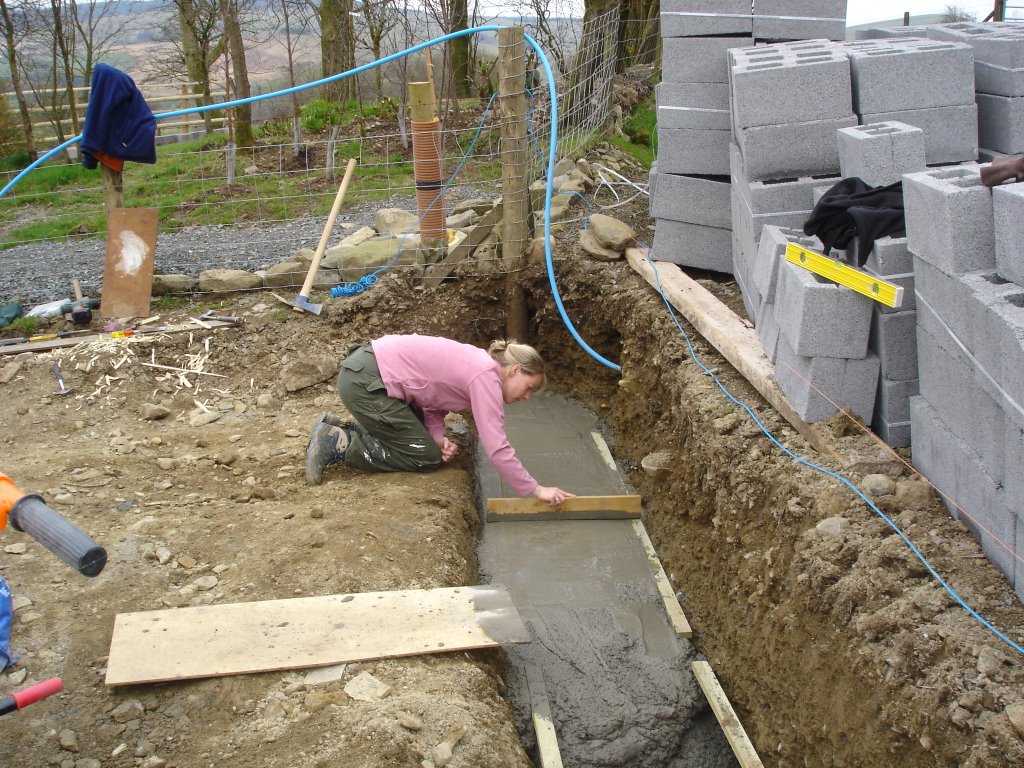
Structural stability – being a barn, the walls are not built on foundation so in order to add a first floor, the barn would have to be underpinned, a tedious labour intensive job.
Services – the barn will be fed from a spring further up the hill which will be filtered on route to the tap. We are lucky to not be too far away from a source of electricity which will be routed underground to the barn. Mains gas is not an option in this location so the heating will rely on oil. We investigated the possibility of geothermal central heating which uses the subterranean heat from the earth to heat the property. The significant cost running cost is that of the electric pump which is need to raise the temperature, thus if the cost of electricity goes up, the whole system becomes expensive to run. We have chosen to adopt under floor heating based on an oil burning boiler which improves the energy efficiency of a building. Ideally we would like to make the barn as eco as possible so are investigating the use of solar panels and windmill electricity generation.
Design – We had a local architect recommended to us who has been very helpful in redesigning the internal layout of the barn. We are restricted to the window openings as set out in the approved planning application drawings unless we resubmit a revised scheme which can be a very lengthy uncertain process.
 June Update – Weeks 11-12
 We were joined on site at the weekend by David (brother) and Chris, and between us added another 3 courses of concrete blocks on the retaining wall- we are nearly there! A much deserved beer was had in front of the England game luckily being shown in the local pub.